Signal or Noise
Otama Jumped From $0.44 to $2.59. Did 342 Tracked Transactions Confirm It?
Thesis
Otama earns a Strong Signal verdict because its exact tracked series recorded two consecutive weeks of exceptional participation while price broke from its former range. The verdict is deliberately narrow: the activity behind the repricing persisted, but one observation at $2.59 cannot establish a durable floor, reveal where every transaction cleared, or explain why buyers appeared.
The One Piece card kept 342 tracked transactions after a 345-transaction breakout week. Participation persisted; the $2.59 floor is still unproven.
A low-dollar card can produce a spectacular percentage without producing a trustworthy market read. When the starting point is measured in cents, even a modest absolute move can make the chart look louder than the participation underneath it.
Otama did something more demanding. The card moved from $0.23 to $0.44 as tracked transactions jumped from 52 to 345. One week later, price accelerated again to $2.59, and tracked transactions remained at 342.
That second participation point is the useful evidence. Buyers did not vanish after the first break. Signal or Noise can call the move a Strong Signal while keeping the more important boundary intact: participation has persisted, but the new price floor has not yet proved itself.
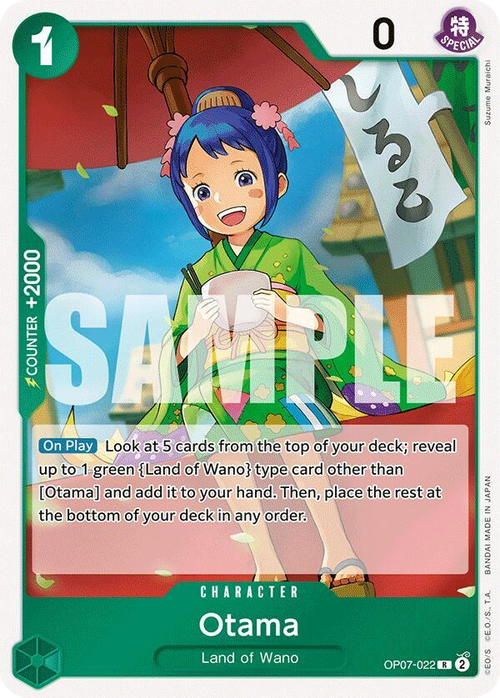
Card Spotlight
Otama
500 Years in the Future
A low-dollar One Piece card whose two-week participation break makes the market-literacy lesson more useful than the headline percentage alone.
Signal or Noise
Participation held. The price floor still has to prove itself.
Strong Signal, price floor unproven: two exceptional activity weeks confirm participation in the repricing event without establishing a durable $2.59 range.
Earlier price band
$0.21 to $0.23
Breakout sequence
$0.44 -> $2.59
Tracked participation
345 -> 342
Support retention
99.13%
Verdict
Strong Signal - price floor unproven
Source: TrendApe W31 tracked TCGplayer evidence for product 545803, series 7871441. This is one exact card series, not total-market One Piece coverage or a price prediction.
Why Readers Should Care
The headline is not simply that a cheap card became less cheap. The lesson is that price confirmation and price durability are different questions.
A single weekly observation with hundreds of tracked transactions can show that a repricing event attracted broad activity. A second week at nearly the same transaction count tells us that the participation break was not confined to one data point. Neither result tells us that every buyer paid the final observed price or that the market will keep trading near $2.59.
That distinction matters beyond Otama. Collectors often treat high activity as proof that a new price is safe, or dismiss a low-dollar move because the percentage looks exaggerated. The evidence supports neither shortcut.
It supports a narrower, more useful conclusion: this repricing had sustained tracked participation, and the price now has to prove it can hold.
The Two-Week Participation Break
Before the repricing, the visible eight-week price range stayed between $0.21 and $0.23. Tracked transactions ranged from 7 to 52.
The transaction count retained 99.13% of the prior week's level. That is the hero proof. The card did not need an even larger second-week count to confirm participation; it needed to avoid collapsing toward its former range. On the current record, it did.
The price story is less mature. $2.59 appears only once in the weekly series. Participation has a two-point confirmation. The latest price range has a one-point observation.
- Price moved from $0.23 to $0.44 while tracked transactions rose from 52 to 345.
- Price moved again from $0.44 to $2.59 while tracked transactions held at 342.
What The Data Actually Says
For most of the window, Otama behaved like a sub-quarter card with modest weekly participation. The final two observations broke that pattern. The first established an activity surge; the second showed that activity remained exceptional even as the observed price climbed almost sixfold week over week.
This rules out the narrowest noise case: the chart was not lifted by one or two tracked transactions in an inactive series.
It does not rule out a reversal, a catalyst-driven rush, or transactions clearing across a wide range below the final observed price.
- Price path: $0.23 -> $0.22 -> $0.21 -> $0.23 -> $0.22 -> $0.22 -> $0.22 -> $0.23 -> $0.44 -> $2.59
- Transaction path: 9 -> 10 -> 7 -> 18 -> 32 -> 15 -> 9 -> 52 -> 345 -> 342
Two-Week Confirmation
The participation break held while price accelerated.
Tracked transactions moved from 345 to 342 across the two breakout observations. That confirms participation in the repricing event, not a durable $2.59 floor.
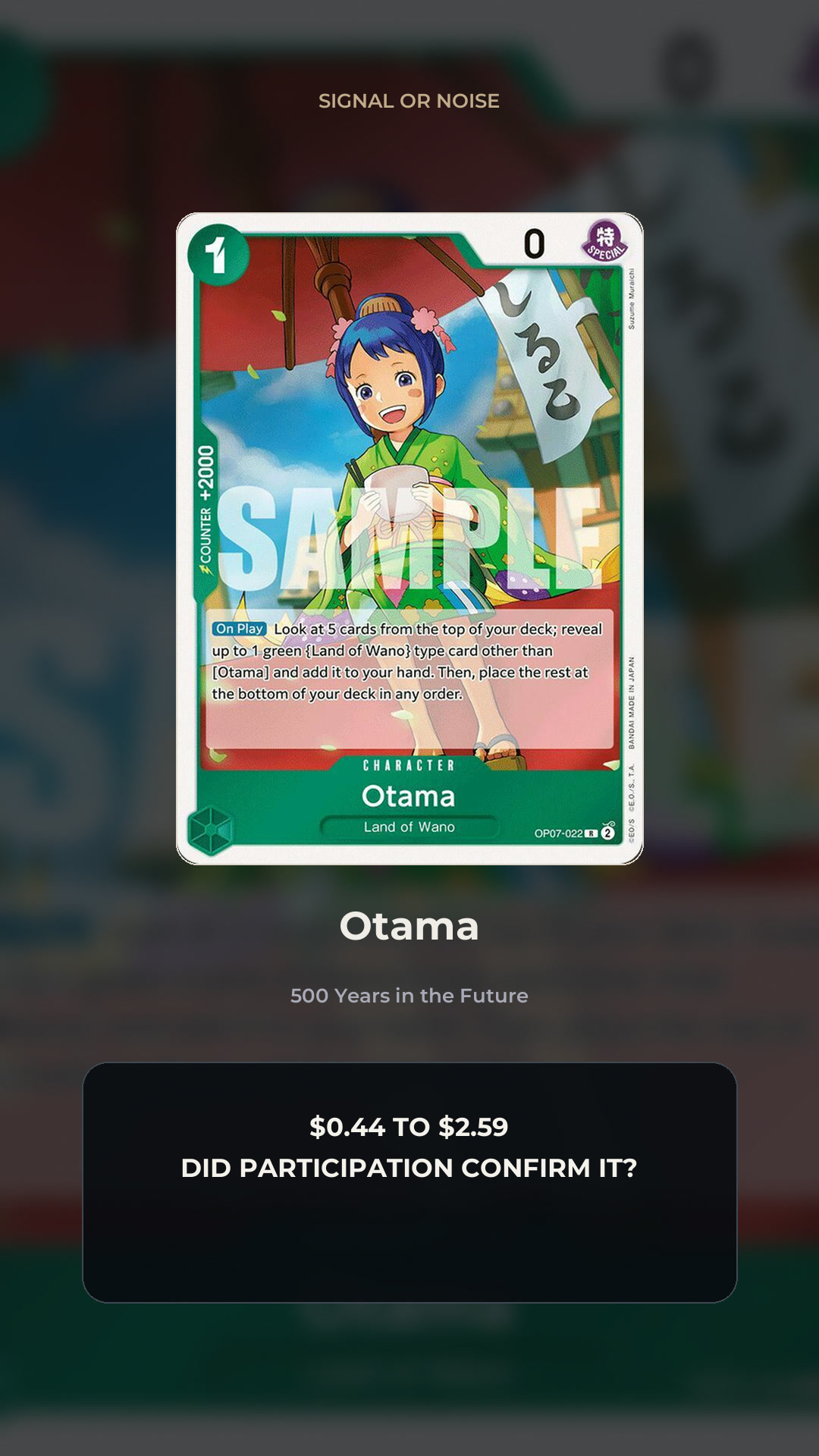
Verdict: Strong Signal
Two consecutive weeks of exceptional tracked participation accompanied the repricing event. That earns a Strong Signal verdict.
What is not confirmed is just as important: the catalyst, the clearing price of every transaction, and a durable $2.59 floor remain unproven.
- Strongest objection: Weekly aggregation proves activity during the move, not that 342 transactions cleared at the terminal observed price.
- Falsifier: The thesis weakens if the next same-series observations lose most of the new range while transactions fall back toward the former 7-to-52 baseline.
Why This Is Signal or Noise
A Market Snapshot could report Otama's latest price and percentage change. This feature asks the stricter question: did participation persist after the initial breakout?
The current evidence says yes. Tracked activity held almost flat from 345 to 342 transactions instead of returning toward the former range. That earns the Strong Signal label.
The label is not a forecast. It describes the participation evidence behind the repricing, not the safety of buying at $2.59, the cause of the move, or the next direction. Strong participation and an unproven price floor can coexist.
Counterevidence And Limits
The latest price is new. There is no second weekly point showing that the exact series continued to trade near $2.59.
Weekly aggregation also hides the sequence of trades inside each window. Some or many of the 342 latest transactions may have cleared below the terminal observed price as the card repriced. Saying that 342 copies sold at $2.59 would go beyond the evidence.
This analysis follows one exact TCGplayer series: Near Mint, foil, English. It does not represent every condition, language, marketplace, private transaction, or local sale.
The card began from a very low base, which magnifies percentage changes. That makes the absolute price path and tracked participation counts more important than the +698.56% headline alone.
The data also does not identify a catalyst. Playability, scarcity, buyouts, reprint expectations, creator attention, and other market explanations remain hypotheses unless separate evidence establishes them.
Evidence & Method
This feature uses the W31 enriched tiered record for Otama, product 545803, exact series 7871441.
TrendApe uses tracked market records within defined card, condition, variant, and time-window boundaries. This does not claim to capture every private, local, or off-platform transaction.
- Visible window: May 18 through July 20, 2026
- Source metric: +698.56% over one month
- Latest weekly change: approximately +488.64%
- Scope: one tracked TCGplayer series, not every condition, language, marketplace, or private transaction
- Boundary: observational market analysis, not a causal finding, price prediction, or investment recommendation
What To Watch Next
The next same-series observation has two jobs.
First, it will show whether tracked participation remains meaningfully above the former 7-to-52 range. Second, it will provide the first follow-up test for the $2.59 price point.
If price retains a meaningful share of the new range while transactions remain elevated, the durability case strengthens. If price gives back most of the move and activity falls toward the old baseline, the current Strong Signal should be remembered as a well-participated repricing event, not an established floor.
That is the reason to return: participation has already answered its first question. Price durability has not.
Market Check
Compare current active listings with the tracked $2.59 point, but do not mistake one seller's ask for completed-market confirmation. The useful follow-up is whether listings, completed activity, and the next exact-series observation begin clustering around a stable range.
Sources & Data
- Source
- TrendApe W31 tracked TCGplayer evidence for Otama from 500 Years in the Future.
- Tracked series
- Series 7871441 - Near Mint, foil, English
- Window
- May 18 through July 20, 2026
- Boundary
- The evidence covers one exact tracked series. It is not total-market truth, a causal explanation, a price prediction, or investment advice.
What to Remember
"Participation persisted. The price floor still has to prove itself."
The Strong Signal verdict describes two weeks of exceptional tracked participation. It is not a price forecast or buying recommendation.
Cards mentioned in this Feature
Use the links below to check current prices for the card at the center of this read.
Affiliate links appear only when they are relevant to the evidence shown in this Feature.
Takeaway
Otama's repricing has two consecutive weeks of exceptional tracked participation. That is strong enough to confirm that the move was not a thin one-point chart artifact. It is not strong enough to establish why buyers appeared, where every transaction cleared, or whether $2.59 becomes a durable floor.