The Pulse
The Pulse: Pikachu Kept Falling. Magikarp Came Back Down.
A $28 slide for Pikachu, a fading Magikarp jump, and two very different quiet price records. Four card stories from the late-September readings.
Pokémon
Pikachu’s drop slowed. It did not stop.
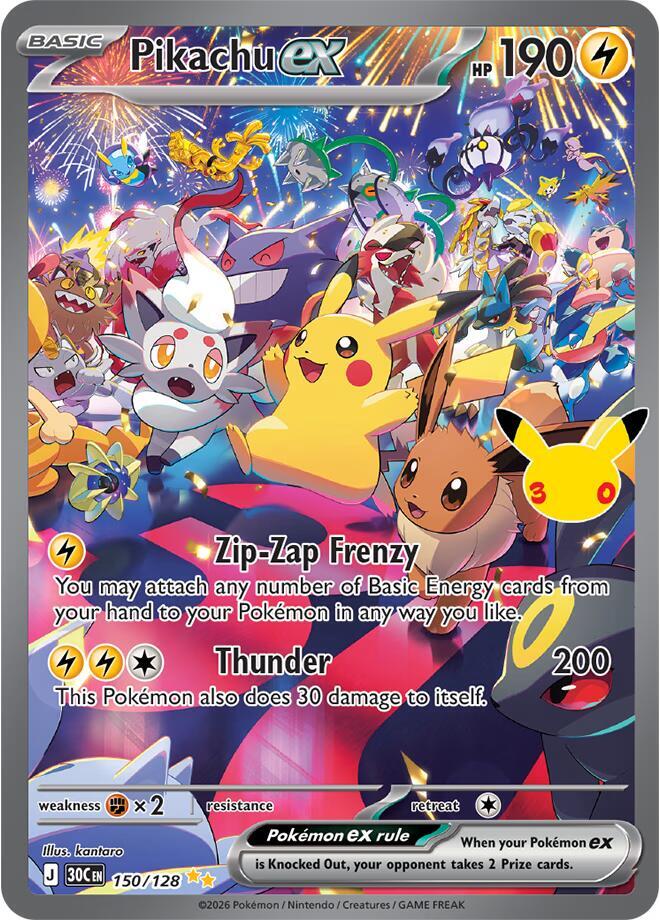
Pikachu ex · 150/128 · ME: 30th Celebration · English Near Mint Holofoil · September 14, 21 and 28, 2026
Four cards ended the period looking softer, but the collector read is not simply “prices went down.” Pikachu’s decline kept extending but slowed; Magikarp nearly erased a one-week jump; Nico Robin went almost flat as recorded transactions dropped; Buzz Lightyear carried the same price through two zero-transaction readings. The useful distinction is what each latest number actually tells us.
The ME: 30th Celebration Pikachu ex, numbered 150/128, went from $108.14 on September 14 to $87.76 on September 21, then $80.48 on September 28. Those observations refer to the English Near Mint Holofoil printing shown above.
For a collector, the shape matters more than the $28 headline. Roughly $20 of the decline happened in the first step and about $7 in the second. The latest observation therefore extends the decline, but at a slower pace. With only three retained weekly points, that is enough to describe the path as still lower and slowing — not enough to call a reversal or a long-established trend.
Across the wider Pokémon sample, 118 tracked prices fell and 62 rose between September 21 and September 28; 19 were unchanged. That context makes Pikachu less isolated without making this printing representative of Pokémon as a whole. If you are comparing a listing with the late-September record, $80.48 belongs at the end of a slowing two-step slide, not one sudden $28 drop.
Magikarp nearly came full circle
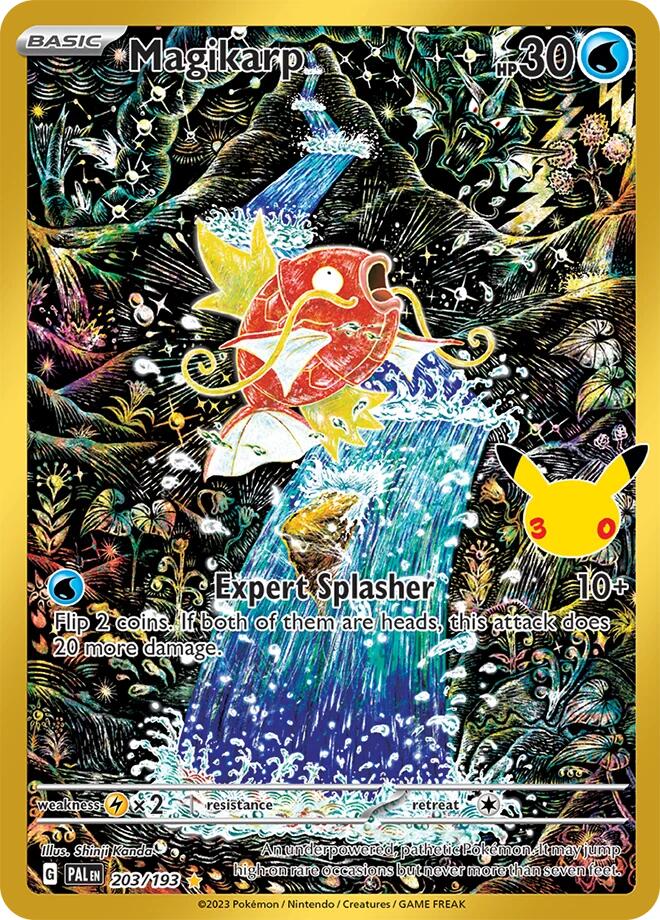
Magikarp’s Classic Collection printing ended the same fortnight only a little above where it began. The middle of the story looked quite different.
Its retained prices were $110.69, $129.84 and $112.36 on September 14, 21 and 28. A start-to-end comparison would make the fortnight look almost unchanged, which misses the collector-relevant part: the middle reading briefly reset the reference point near $130 before the latest price came back down. If you are comparing current asking prices, the September 28 reading sits much closer to the September 14 starting point than to the week-ago spike.
Nico Robin got quieter after the fall

Nico Robin’s 062 Parallel from Emperors in the New World had already done most of its moving before the latest week.
The retained path fell from $162.98 on August 31 to $148.32 on September 7 and $129.68 on September 14. The next two readings were $128.99 and $128.93. By that final step, the change was just six cents.
The last two retained entries contain ten transactions and then two. The six-cent move can look like stability until it is paired with that drop in recorded transactions. For a collector, the safer interpretation is a quiet record, not a confirmed floor: there is less recent transaction evidence behind the near-flat reading.
Buzz Lightyear’s price stayed put without a new recorded sale

Buzz Lightyear — Jungle Ranger (Iconic), from Wilds Unknown, presents a different kind of stillness.
The retained price is $3,621.08 on September 14, 21 and 28. The first of those entries contains one transaction. The next two contain none.
This is the clearest example of why a displayed price is not the same thing as a fresh sale. One transaction appears at the September 14 point, then zero and zero while $3,621.08 stays on the record. For a collector comparing high asking prices, that figure is a retained reference point — not proof that buyers kept paying it week after week.
What these four records mean together
These cards do not resolve into one market verdict, and that is the useful part. Pikachu is a continuing decline that slowed. Magikarp is a round trip whose endpoint hides the middle. Nico Robin is a near-flat reading with less recent transaction evidence behind it. Buzz Lightyear is a carried number without a new recorded sale in the latest two entries.
The collector takeaway is to read the path before treating the latest price as the whole story. The same headline number can mean very different things depending on how the card got there and whether recent transactions actually sit behind it.
Keep reading
Sources & Data
- Evidence & Method
- Frozen TrendApe market evidence captured October 2, 2026. Card paths use the dated retained observations shown in the article; the category comparison uses September 21 → September 28, 2026. No later market movement is incorporated.
- Sample
- The Pokémon category context uses 199 usable paired observations from a 200-product revenue-ranked Cards discovery sample. One missing pair is excluded, not counted unchanged. The four featured cards are selected examples, not a representative sample.
- Limits
- Prices and transaction counts describe retained evidence, not every sale or the total market. A repeated price with zero transactions is not a fresh sale. No causality, demand, scarcity, investment merit or future direction is claimed.